


Contact Info

What Are You Looking For?

OnsysConnect Architecture

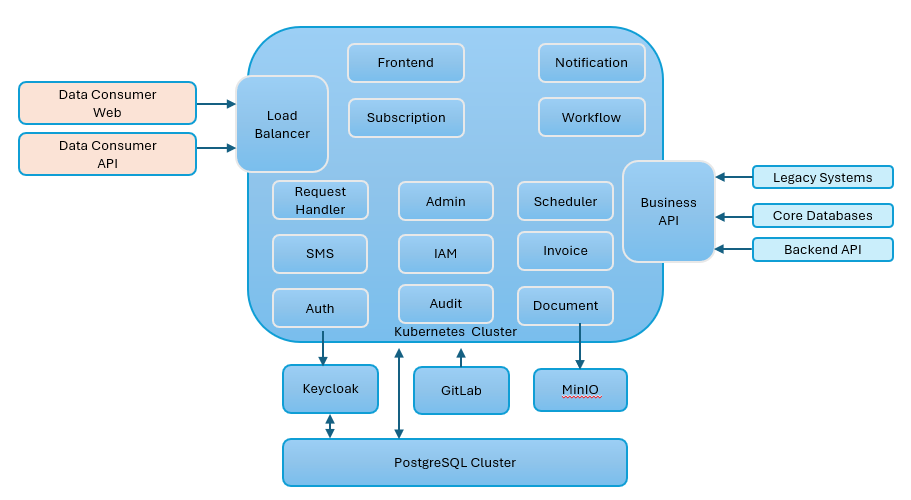
The platform is built on a microservices-based architecture that ensures scalability, security, and flexibility for digital ID ecosystem with data sharing platform.

Micro-Services & Moduler Architecture

Engineered for Customization

OnsysConnect is a microservices-driven digital data sharing platform, designed to enable secure and seamless information exchange between organizations (data providers and consumers). This architecture is modular, scalable, and designed with enterprise-grade security in mind.

Built for Maximum Flexibility

  • Data Consumer Layer
  • Application Layer (Kubernetes Cluster)
  • Data & Infrastructure Layer

Data Consumer Layer

  • Data Consumer Web:

    Provides a ReactJS-based front-end portal for organizations (e.g., banks, financial institutions) to request data, validate identities, and manage subscriptions through an intuitive interface.

  • Data Consumer API:

    Exposes RESTful APIs for direct backend integration. External systems can consume services programmatically, e.g., validating NIC, company details, or vehicle information in real-time.

  • Load Balancer:
    • An Nginx-based load balancing cluster ensures high availability and performance.
    • Distributes requests from consumers to the backend microservices.
    • Implements SSL termination, reverse proxy, rate-limiting, and access control (e.g., IP whitelisting).

Application Layer (Kubernetes Cluster)

The Kubernetes cluster is the heart of OnsysConnect, hosting all microservices as independent, containerized units. This design ensures that each function can scale independently and be updated without affecting other services.

Key Microservices:

  • Frontend Service:

    Serves the ReactJS interface for web-based users.

  • Subscription Service:

    Manages subscription plans, API quotas, and access for data consumers.

  • Notification & Workflow Services:
    • Notification: Handles email/SMS alerts for approvals, status updates, or system messages.
    • Workflow: Manages dynamic approval flows for requests, ensuring multi-level verification.
  • Request Handler:

    Orchestrates incoming API calls, validates requests, and routes them to appropriate backend services.

  • Admin & IAM (Identity & Access Management):

    Allows administrators to manage organizations, roles, users, and security policies.

  • Scheduler & Invoice Services:

    Automates scheduled tasks (e.g., generating invoices), monthly billing, and subscription reminders.

  • Auth & Audit Services:
    • Auth: Works with Keycloak for secure authentication and JWT token generation.
    • Audit: Logs all activities, requests, and responses for compliance and reporting.
  • Document Service:

    Handles secure document storage and retrieval, integrated with MinIO for object storage.

  • Business API:

    Acts as a central bridge to legacy systems , core databases, and external APIs

Data & Infrastructure Layer

  • Keycloak:

    Provides SSO (Single Sign-On), OAuth2.0/JWT-based authentication, and fine-grained access control.

  • GitLab:

    Manages source control and CI/CD pipelines. GitLab Actions automate deployment of microservices to Kubernetes, ensuring continuous delivery.

  • MinIO:

    A highly available, S3-compatible object storage for documents, agreements, and logs.

  • PostgreSQL Cluster:

    The primary relational database for transactional data, with stream replication for fault tolerance and backup.

  • Backend & Legacy Systems Integration:
    • OnsysConnect communicates with government databases, or other 3rd party APIs via the Business API layer.
    • Ensures real-time data retrieval and validation.

Data Flow

  1. Consumers (Web/API) submit data requests to OnsysConnect via the Load Balancer.
  2. Requests are routed to the appropriate microservice (e.g., identity verification, workflow, audit).
  3. Business APIs retrieve or validate data from core databases or government sources.
  4. Responses are logged, audited, and sent back to the consumer in real time.

Key Highlights

  • Microservices Architecture – Each service is independent, ensuring better fault isolation and scalability.
  • Containerized Deployment – All services run on Kubernetes, enabling auto-scaling and load handling.
  • Enterprise Security – Enforced via Keycloak, JWT, SSL, IP whitelisting, and audit trails.
  • Data Ownership & Compliance – Organizations control which data elements are shared with whom.
  • On-Premise or Cloud – Flexible deployment on AWS, Azure, GCP, OCI, or private data centers.

Key Strengths

  1. Scalable Microservices: Each service (e.g., audit, subscription, notification) can scale independently.
  2. High Availability: Nginx load balancer, Kubernetes clustering, and PostgreSQL replication ensure zero downtime.
  3. Security-Focused: JWT, Keycloak IAM, SSL encryption, and strict role-based access control protect sensitive data.
  4. Hybrid Deployments: Supports on-premises or cloud (AWS, Azure, GCP, OCI).
  5. DevOps Ready: GitLab CI/CD pipelines ensure rapid and reliable deployments.
  6. Real-Time Integrations: Fast, API-driven connectivity with banking, government, and third-party systems.

Key Use Cases

Real-time NIC verification for banking and financial institutions.

Insurance certificate verification before loan disbursement.

Cross-organization secure KYC data sharing.

Seamlessly share verified vehicle details from the motor registry with insurers and lenders—secure, instant, and trusted.

Effortlessly share your latest product catalog, pricing, and updates with partner organizations—always accurate, always up to date.

Share complete product manufacturing details with customers—origin, batch, sourcing, and production—empowering real‑time verification and traceability.

Enable data sharing from legacy backend systems to power modern mobile applications—without costly infrastructure investments.

Request a free demo